Fiber laser source stability
High electrical efficiency and controlled power delivery help keep weld penetration consistent across long shifts, mixed lot sizes, and heat-sensitive assemblies.
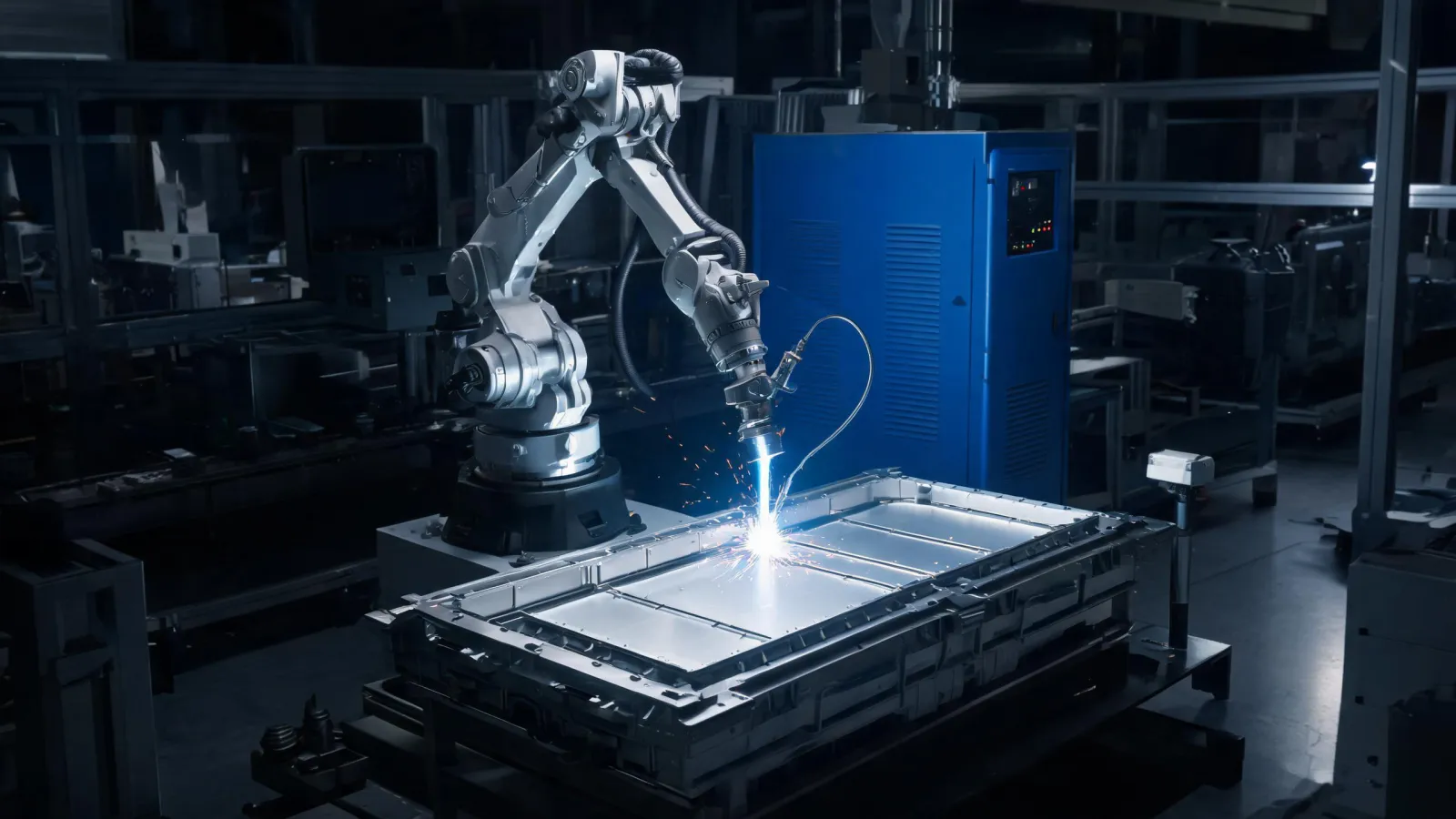
Connect high-brightness fiber lasers, beam delivery, seam monitoring, and robotic motion into a welding process built for battery packs, precision metal assemblies, and automated fabrication.
IPG Photonics projects start with material behavior, beam geometry, fixture stability, and production takt time. The result is a welding cell that operators can run, quality teams can audit, and manufacturing leaders can scale.
High electrical efficiency and controlled power delivery help keep weld penetration consistent across long shifts, mixed lot sizes, and heat-sensitive assemblies.
Scanner optics, fixed heads, wobble patterns, and shielding setups can be selected around lap joints, hairpins, tabs, housings, and precision seams.
Robot, PLC, safety, and vision integration are planned as a system, so the welding station behaves like part of the line rather than a separate island.
Trial welds, cross-section review, and parameter capture create a practical window for power, speed, focus, shielding, and fixture tolerance.
Photodiode signals, vision checks, weld presence data, and recipe controls can support traceability when a missed seam would stop downstream production.
Application review, service planning, and spare-parts strategy help multi-site teams transfer a validated weld recipe without rebuilding the process from scratch.
Use these planning bands to frame the engineering conversation. Final values depend on alloy, coating, joint geometry, clamping, shielding gas, and inspection criteria.
| Planning Item | Typical Engineering Range | Why It Matters |
|---|---|---|
| Power class | 1 kW to 12 kW fiber laser platforms | Balances penetration, speed, spatter behavior, and thermal impact. |
| Beam strategy | Fixed, scanner, wobble, or hybrid optics | Adapts the energy profile to seam width and fit-up variation. |
| Materials | Aluminum, stainless steel, copper, nickel alloys | Material reflectivity and conductivity drive source and recipe choice. |
| Cell Area | Integration Target | Control Focus |
|---|---|---|
| Motion | Robot arm, gantry, or rotary indexing | Path accuracy, acceleration limits, and service access. |
| Part handling | Manual load, conveyor, or pallet transfer | Repeatable datum contact and clear operator workflow. |
| Safety | Class 1 enclosure planning | Interlocks, viewing windows, extraction, and access control. |
| Quality Layer | Common Evidence | Production Use |
|---|---|---|
| Recipe control | Locked parameters and operator levels | Prevents drift after process approval. |
| Inspection | Cross sections, peel tests, leak checks | Confirms joint strength and hermetic needs. |
| Traceability | Serial, lot, and weld-event records | Links weld conditions to finished assemblies. |
Fiber laser welding earns its place when distortion, takt time, and rework cost matter at the same time. These are the environments where a validated IPG Photonics process can change the economics of joining.
Faster tab and busbar weld sequencing when fixtures, beam delivery, and recipes are engineered together.
Precision seam placement for housings, brackets, and light-gauge assemblies with controlled heat input.
Traceable parameter sets for programs that need documented process windows and reviewable weld evidence.
Shift-ready cell planning for stainless, aluminum, and mixed-material production runs.
Share the part drawing, current defect pattern, and production goal. IPG Photonics can help frame source power, optics, safety enclosure, fixture control, and inspection evidence before capital approval.